Why is my mini-split blowing warm air? A Florida homeowner's guide
Your mini-split is humming away, the indoor unit's fan is spinning, and yet the air drifting out of the vanes feels disappointingly warm. In Florida heat, that's not a minor annoyance - it's a problem that needs solving fast. The good news is that most of the common causes are well understood, and some of them you can address yourself in the next ten minutes.
This guide walks through every likely reason a ductless mini-split blows warm air in our Gulf Coast climate, from the dead-simple to the more involved. We'll cover what's going on inside the system, why Florida's heat and humidity make some of these issues worse than they'd be up north, and exactly what the diagnostic process looks like.
First: make sure the system is actually set to cool
It sounds obvious, but it happens more than anyone admits. Mini-split remote controls have multiple operating modes: cool, heat, fan-only, dry, and auto. If the unit was switched to "heat" or "fan-only" mode accidentally, it will move air without cooling it. Check your remote and confirm the snowflake icon or "COOL" label is selected. Also check the set temperature - if someone bumped the thermostat up to 82°F and the room is 79°F, the system has no reason to run the compressor at all.
If you have a multi-zone system, each indoor unit typically has its own remote or app control. It's worth checking every zone individually before assuming there's a mechanical problem.
Low refrigerant is the most common culprit
Refrigerant is the substance that actually absorbs heat from your indoor air and carries it outside. When the refrigerant charge is too low, the system loses its ability to pull heat effectively, and the air coming out of the indoor unit never gets cold.
In Florida, refrigerant loss almost always means there's a leak somewhere in the line set or at a fitting. Refrigerant does not "get used up" like fuel - a properly sealed system holds its charge for the life of the equipment. If it's low, something has allowed it to escape.
Signs that point to a refrigerant issue include:
- The indoor unit blows air that's cool-ish but never really cold, even after running for 20-30 minutes
- Ice forming on the indoor or outdoor unit (counterintuitive but common - ice means the coil is too cold in one spot because refrigerant pressure is off)
- A hissing or bubbling sound near the line set or the outdoor unit
- Higher-than-normal electricity bills because the compressor is working overtime
A refrigerant leak is not a DIY repair. Handling refrigerants legally requires EPA Section 608 certification. A technician will locate the leak, repair it, and recharge the system to the manufacturer's specification. If you're in Sarasota, Bradenton, or anywhere along the coast and you suspect a leak, getting it addressed quickly prevents compressor damage that's far more expensive to fix.
A dirty air filter is starving the system
Every indoor mini-split head has a washable mesh filter sitting just inside the front panel. That filter catches dust, pet hair, and the fine particulate matter that drifts in from open doors and windows - something Florida homes deal with constantly given how much time we spend moving between indoors and outdoors.
When the filter is clogged, airflow across the evaporator coil drops dramatically. Less air moving over the coil means less heat transfer, which means the air coming out feels barely cool. In some cases the coil will ice over from the restricted airflow, which makes things even worse.
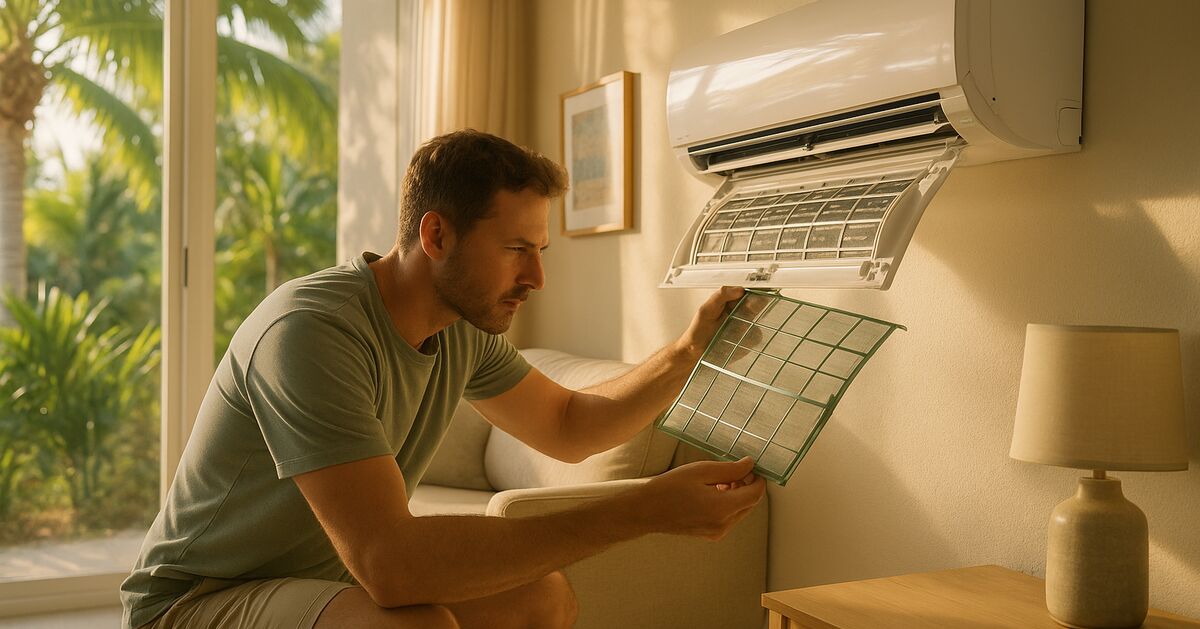
The fix is almost always free: slide the front panel up, lift out the filters, rinse them under warm water, let them dry completely, and reinstall. Most manufacturers recommend doing this every two to four weeks during heavy-use periods. In coastal areas like Anna Maria Island, Casey Key, and Osprey, salt-air particulates can clog filters faster than you'd expect, so check yours more often than the manual suggests.
The outdoor unit is overheating or blocked
The outdoor condenser unit has one job: dump the heat your indoor unit extracted from your living space into the outside air. When something interferes with that process, the whole system backs up and cooling efficiency collapses.
Common outdoor unit problems in our area include:
- Debris blocking the coil fins. Leaves, grass clippings, and seed pods from palms and oaks pack into the fins and insulate them. Gently rinsing the coil with a garden hose (spray downward through the fins, not upward) often restores airflow significantly.
- Overgrown landscaping. Shrubs and ornamental grasses planted close to the unit restrict the airflow the condenser fan needs to work. Manufacturers typically require 18 to 24 inches of clearance on all sides.
- Direct afternoon sun with no shade. West-facing units baking in the full Florida afternoon sun work harder and run hotter. This rarely causes complete warm-air output by itself, but it reduces efficiency noticeably.
- A failing condenser fan motor. If the outdoor fan isn't spinning, heat has nowhere to go. You can usually see or hear this from a few feet away.
The evaporator coil is frozen or iced over
Ice on a mini-split coil is counterintuitive - it seems like a cold system would be working great, right? Actually, ice on the coil blocks airflow and insulates the refrigerant lines from the room air they're supposed to be cooling. The result is warm, barely-moving air from the indoor unit.
Ice forms when:
- The air filter is heavily restricted (covered above)
- Refrigerant charge is low
- Outdoor temperatures drop below the system's rated operating range (less relevant in a Florida summer, but relevant for overnight operation in January)
- The blower fan inside the indoor head is failing and barely moving air
If you see or suspect ice, turn the system off and let it thaw completely - usually a few hours. Running it in fan-only mode speeds this up. Once thawed, clean the filter and restart. If it ices again within a day or two, the underlying cause (usually refrigerant or a fan issue) needs professional attention.
Electrical and control board problems
Less common but worth mentioning: mini-splits have control boards that manage the communication between the indoor and outdoor units. A failing board can cause the outdoor compressor to not engage at all, leaving you with a fan blowing unconditioned air. This is harder to diagnose without a multimeter and some technical know-how.
Symptoms that suggest an electrical or board issue rather than a refrigerant or airflow problem:
- Error codes flashing on the indoor unit's display (look them up in your manual or check the brand's website)
- The outdoor unit makes no sound at all while the indoor fan runs
- The system randomly shuts off and restarts
- The remote control seems to work (the unit beeps) but nothing actually changes
If you're seeing error codes, write them down before calling a technician. That information cuts diagnostic time significantly.
Florida-specific factors that make this worse
Our climate creates a few conditions that make warm-air problems more likely here than in, say, North Carolina.
Humidity loads are extreme. A mini-split doing heavy dehumidification work runs the indoor coil very cold, which increases the chance of icing if anything else is slightly off. We've written more about why Gulf Coast humidity sometimes overwhelms mini-splits and what to do about it - it's worth a read if you're dealing with both warmth and clamminess at the same time.
Salt air degrades equipment faster. Homes on Casey Key, Longboat Key approaches, and along Bayshore Gardens face corrosion on coil fins and electrical contacts that accelerates the kind of wear that leads to refrigerant leaks and fan motor failures. Regular professional maintenance is genuinely more important here than in inland areas.
High ambient temperatures push outdoor units hard. When it's 95°F in the shade at 2 p.m. on a Lakewood Ranch afternoon, the outdoor unit is trying to dump heat into already-hot air. Systems that are slightly undersized or slightly low on refrigerant that would muddle through in milder climates simply can't keep up here. We have a detailed post on whether your mini-split is properly sized for your space that explains how to think through this.
What you can check yourself right now
Before calling for service, run through this list:
- Confirm the remote is set to COOL mode and the set point is below the current room temperature
- Check and clean the air filter
- Walk outside and look at the condenser unit - is the fan spinning? Is there debris on the coil? Is vegetation crowding the unit?
- Look for ice on any part of the system you can see
- Check for error codes on the indoor unit's display
If those steps don't reveal anything obvious and the system still blows warm air, it's time to call a technician. Continuing to run a system that's low on refrigerant or has a failing compressor can turn a moderate repair into a full unit replacement.
What a service call actually looks like
A qualified technician will connect manifold gauges to the service ports on the outdoor unit to check refrigerant pressure. They'll measure the temperature split between the air going into the indoor unit and the air coming out (a properly working system should produce air that's 15 to 20°F cooler than the return). They'll check electrical connections, capacitor readings, and fan motor performance.
Most diagnostic visits take under an hour. If a refrigerant leak is found, the repair time depends on where the leak is located - a fitting leak at the line set connection is a quick fix, while a leak in the coil itself may mean coil replacement. A good technician will explain all options clearly before starting any repair work.
You can learn more about all the ductless mini-split installation and service work we do or read through common questions homeowners ask before scheduling to know what to expect.
When replacement makes more sense than repair
If your system is more than ten years old, has had multiple refrigerant leaks, or needs a compressor replacement, the math on repair vs. replace often shifts. A new system will be more efficient, carry a fresh warranty, and use current refrigerant standards. Our post on how long a mini-split actually lasts in Florida's climate walks through the realistic lifespan factors in detail.
Homeowners across Venice, Nokomis, and Lakewood Ranch often find that a system installed in the early 2010s has delivered solid value and that a replacement now - while the older unit still works partially - avoids the emergency-replacement scramble during peak summer heat.
The bottom line
A mini-split blowing warm air is almost always one of a handful of fixable problems: wrong mode, dirty filter, blocked outdoor unit, low refrigerant, or ice buildup. Start with the free checks, handle what you can, and get professional help for anything involving refrigerant or electrical components. Catching these issues early keeps repair costs reasonable and, more importantly, keeps your home comfortable through a Florida summer.
If you're ready to get eyes on your system, reach out and we'll set up a visit. We serve homeowners throughout Sarasota, Bradenton, Anna Maria Island, Osprey, and the surrounding Gulf Coast communities, and we'd rather you call us early than wait until a manageable problem becomes a full replacement.