Is your mini-split the right size? What Sarasota homeowners need to know
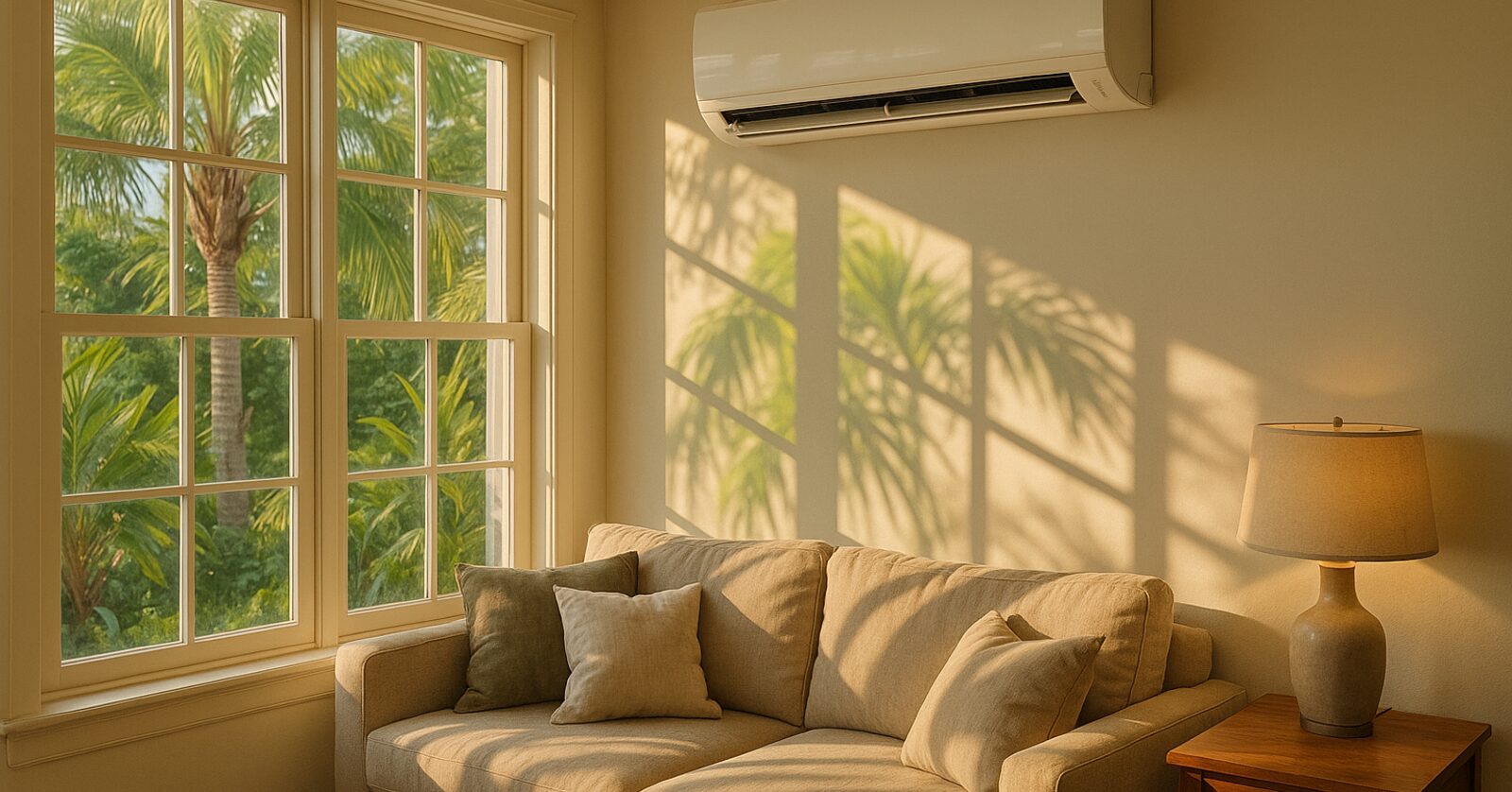
Getting the size wrong is the single most common mini-split mistake homeowners make, and it's almost always invisible until the system is already installed, paid for, and running.
Too small, and the unit runs flat-out every afternoon while your living room stays stuffy. Too large, and the compressor short-cycles, never runs long enough to pull real moisture out of the air, and leaves you with that clammy, "cool but not comfortable" feeling that Sarasota summers are famous for. Neither problem is cheap or easy to fix after the fact. That's why sizing deserves its own conversation, separate from brand comparisons or installation day logistics.
Why sizing is harder in Florida than almost anywhere else
In most of the country, HVAC sizing is primarily a heating problem. Engineers size a system to handle the coldest possible day, and cooling capacity tends to follow naturally.
In Sarasota, Bradenton, Lakewood Ranch, and Venice, the calculation flips. You are sizing for a cooling and dehumidification problem that lasts nine or ten months out of the year. The design day isn't a January cold snap. It's a July afternoon with 92-degree temperatures, full sun on a west-facing wall, and relative humidity sitting at 80 percent or higher.
That combination changes everything. A system that looks "right" on paper using a generic square-footage rule might be undersized because the calculator didn't account for your home's direct western exposure. Or it might be oversized because someone used a northern-climate rule of thumb that doesn't account for how well-insulated modern Florida homes actually are.
The short version: Florida sizing requires a real load calculation, not a rule of thumb.
The square-footage myth
You've probably seen the chart. Something like "9,000 BTU for up to 350 square feet, 12,000 BTU for up to 550 square feet," and so on. Those numbers aren't wrong exactly, but they're a starting point, not an answer.
Here's what those charts leave out:
- Ceiling height. An 8-foot ceiling in a 400-square-foot room holds less air volume than a vaulted 12-foot ceiling in the same footprint. Volume matters more than floor area.
- Window area and orientation. A room with two large south-facing windows in July gains far more solar heat than the same room with one small north-facing window. A BTU chart has no way to account for this.
- Insulation quality. Older homes in Downtown Sarasota, Bayshore Gardens, and parts of Anna Maria Island may have minimal wall insulation by modern standards. Newer construction in Lakewood Ranch or Osprey often has foam-sealed envelopes that dramatically reduce the load.
- Occupancy and internal heat gains. A home office with multiple computers and monitors generates significant heat. A seldom-used guest room doesn't.
- Local climate data. The design temperature for Sarasota is different from Atlanta, Phoenix, or Chicago. If a sizing tool defaults to a generic "hot climate" number, it may still be off by several degrees.
None of this means the square-footage chart is useless. It's fine for a very rough ballpark, the kind of number that tells you whether you're shopping in the 9,000-BTU range or the 18,000-BTU range. But it should never be the final answer.
What a proper load calculation actually looks like
A real load calculation is called a Manual J, named after the Air Conditioning Contractors of America standard. It takes into account every variable that drives heat gain or loss in a specific room or zone: floor area, ceiling height, wall and ceiling R-values, window size, glass type, orientation, local design temperatures, shading from overhangs or trees, and internal heat sources.
Done properly, a Manual J produces a cooling load number in BTUs per hour for each zone you want to condition. That number, matched against a system's rated capacity at real operating conditions (not just the nominal rating on the box), gives you a defensible answer.
This matters especially on Casey Key, Nokomis, and coastal Sarasota properties, where high ambient humidity is a constant and the system's sensible heat ratio (how much of its work goes toward cooling versus dehumidification) becomes a critical design factor. You can learn more about why dehumidification is such a big deal on the Gulf Coast in our post on why your mini-split isn't killing Gulf Coast humidity and how to fix it.
The real cost of oversizing
Most homeowners worry about buying too small. Undersizing is an obvious, visible problem: the room doesn't cool down, the system runs constantly, and energy bills spike. But oversizing is actually the more common mistake, and it causes more damage over the long run.
Here's what happens when a mini-split is too large for its space:
Short-cycling. The unit reaches the thermostat setpoint quickly and shuts off. It then restarts a few minutes later as temperatures drift back up. Each start-stop cycle is hard on the compressor and refrigerant components.
Poor dehumidification. Removing moisture from the air requires sustained airflow across a cold coil. When a system short-cycles, the coil never gets cold enough for long enough to do a real dehumidification job. You end up with a space that feels cold but humid, which is genuinely uncomfortable and can encourage mold growth.
Higher long-term costs. Frequent cycling accelerates wear. Compressors that should last 15 or 20 years may need major work at year eight or ten.
Wasted money upfront. You paid for capacity you don't need and will never use.
This is especially relevant in tightly built new construction in Lakewood Ranch and the Main Street corridor, where energy-efficient homes with low infiltration rates actually need less cooling capacity than their square footage might suggest.
The real cost of undersizing
Undersizing is equally problematic, just in different ways.
A unit that's too small for a space will run almost continuously during summer afternoons. On the surface that sounds fine: the system is working hard, doing its job. But continuous maximum-load operation reduces equipment life, increases energy consumption, and leaves the room slightly warmer than it should be during peak demand periods.
In rooms with significant solar gain, like a sunroom facing west on Anna Maria Island or a Florida room in Venice, undersizing can mean the difference between a usable space and one you abandon after noon from May through October.
For a deeper look at how to evaluate a specific space before shopping, our guide on single-zone vs. multi-zone ductless systems for Florida homes walks through how to think about zone-by-zone load before you commit to a configuration.
Factors that are easy to overlook
A few variables show up again and again in sizing conversations that homeowners frequently underestimate:
Duct leakage in hybrid systems. If you're adding a mini-split to supplement an existing ducted system, the condition of the existing ductwork affects how much work the new unit actually needs to do.
Heat from above. In Florida homes where the attic acts as a radiant heat source, ceiling insulation levels have an outsized effect on cooling load. A poorly insulated attic in a Downtown Sarasota bungalow can add thousands of BTUs per hour to the upstairs load.
Door habits. An open-plan home where spaces flow together requires a different approach than a traditional floor plan with closed rooms. Mini-splits condition the zone they serve; if that zone is constantly exchanging air with adjacent unconditioned spaces, the effective load rises significantly.
Future changes. Planning to add a wall of windows? Enclose a porch? Add a room? Sizing decisions made today should account for changes you expect to make within the next few years.
What "tonnage" and "BTU" actually mean
You'll hear both terms in mini-split conversations, and they mean the same thing expressed differently.
One ton of cooling equals 12,000 BTUs per hour. So a 2-ton system is a 24,000 BTU unit. The terminology comes from the era of ice-based cooling, when one ton of ice melting over 24 hours absorbed roughly 12,000 BTUs per hour. The math stuck even though the ice is gone.
Mini-splits are commonly sold in sizes from 6,000 BTU (half-ton) up to 36,000 BTU (three-ton) for single-zone units. Multi-zone systems can combine multiple indoor heads on a single outdoor unit with a total capacity that may reach 48,000 BTU or more. Our mini-split services page covers the full range of systems we install across Sarasota County and Manatee County.
What to ask your installer before you commit
A trustworthy installer should be able to answer these questions before any equipment is ordered:
- "Did you perform a Manual J load calculation, or are you using square-footage estimates?"
- "What design conditions are you using for the outdoor temperature and humidity?"
- "How did you account for window orientation and solar gain in this room?"
- "What is the system's rated capacity at real Florida operating conditions, not just nominal capacity?"
- "If I add the Florida room or garage conversion later, does this system have room to grow, or will I need a new outdoor unit?"
If the answers are vague, or if the installer jumps straight to brand and price without discussing load, that's a signal to keep shopping.
You can also read through our frequently asked questions for a plain-English explanation of how we approach system sizing and design.
Inverter technology changes the margin for error, but doesn't eliminate it
Modern inverter-driven mini-splits can modulate their output over a wide range, often from roughly 30 percent to 100 percent (or higher) of rated capacity. That flexibility gives some margin on sizing errors: a system that's slightly oversized can dial back its output and still run long enough to dehumidify properly.
But "some margin" is not the same as "it doesn't matter." A system that's 50 percent oversized will still short-cycle badly, even with inverter technology. The modulation range is wide, but it has limits. And a system that's significantly undersized will simply run at maximum output around the clock and still fall short on design days.
Inverter technology is a real advantage, but it's not a substitute for getting the size right. You can see how we approach this in practice on our Sarasota mini-splits location page.
Getting it right before installation day
The best time to have a serious sizing conversation is before anyone picks up a drill. Once the line set is run and the indoor head is mounted, changing to a different capacity unit means uninstalling what's already there. That's not impossible, but it adds cost and hassle that a proper design process would have avoided entirely.
If you're earlier in the process and trying to understand what installation day actually looks like, our walkthrough of what to expect on mini-split installation day is a good read before you schedule.
And if you're ready to move forward and want an honest assessment of what your specific space actually needs, request a free quote and we'll start with a real load conversation, not a square-footage chart.
Sarasota's climate is demanding. The homes here are varied, from 1960s ranch houses in Bayshore Gardens to new construction in Lakewood Ranch to Old Florida cottages on Casey Key. No single rule of thumb covers all of them. What works is a methodical look at the actual space, the actual conditions, and the actual system performance at those conditions. That's the only way to get sizing right the first time.