Cooling a boat dock, lanai, or outdoor structure on Casey Key
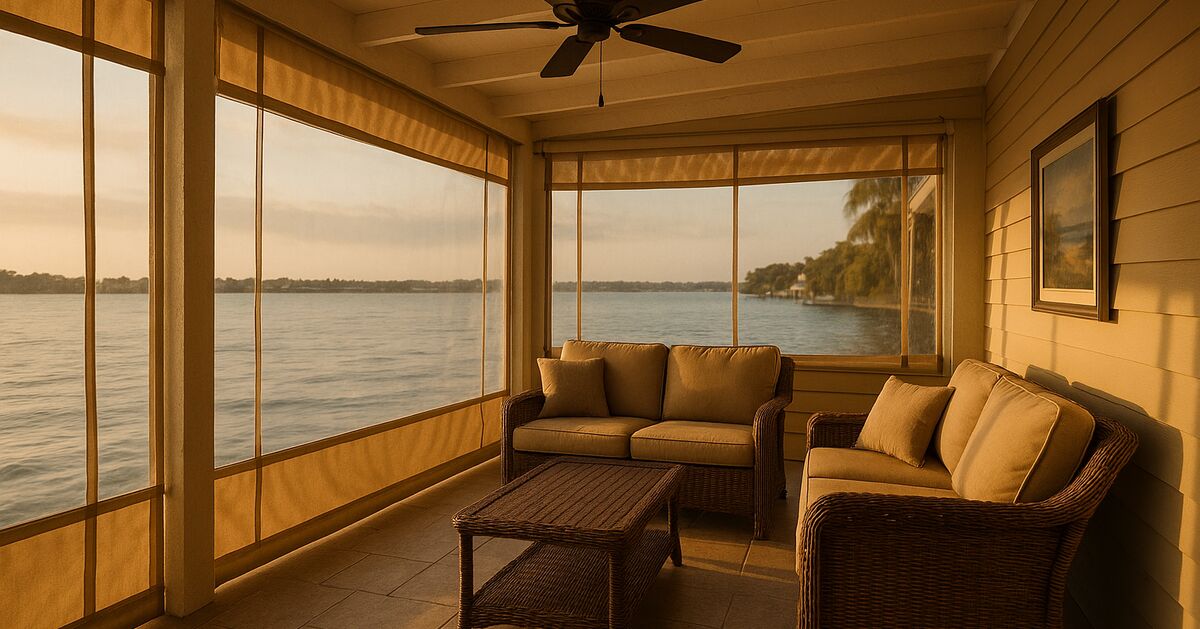
Salt air, a gentle breeze off the Gulf, and a ceiling fan spinning lazily overhead - outdoor living on Casey Key is genuinely special. But from May through October, the heat index regularly climbs past 105°F, and even the bravest waterfront homeowner eventually retreats inside. That raises a question we hear constantly: "Can I put a mini-split on my boat dock, covered lanai, or outdoor living structure?"
The honest answer is: sometimes yes, sometimes partially, and sometimes the physics just win. This post will walk you through what's actually possible, what installers look at before they agree to the job, and what you can do instead when a mini-split isn't the right tool.
Why open-air spaces are fundamentally different from rooms
A mini-split - or any air conditioner, for that matter - works by removing heat and humidity from a defined, enclosed volume of air. Walls, a ceiling, and some form of weather barrier create that volume. The equipment conditions the air inside, and the building envelope slows the rate at which unconditioned air floods back in.
An open-air structure has no envelope. Every cubic foot of cooled air drifts away the moment it leaves the unit, replaced immediately by hot, saturated Gulf Coast air. Running a mini-split in a fully open space is a bit like trying to cool the outdoors with a garden hose: the equipment runs continuously at full capacity, never satisfies its thermostat, racks up enormous electricity bills, and burns itself out years ahead of schedule. No reputable installer will recommend that, and a good one will tell you so plainly before you spend a dime.
That said, "open-air" covers a wide spectrum. Let's break down the most common structures on Casey Key and neighboring barrier islands.
Covered lanais and screened enclosures
A screened lanai is the most workable candidate. Fiberglass screen mesh dramatically reduces airflow compared to open space, and the roof overhead eliminates direct solar gain on the floor and furniture. If the lanai is also fitted with roll-down clear vinyl curtains or EZ-Breeze-style polycarbonate panels, you're approaching a semi-conditioned room.
For screened enclosures with vinyl or polycarbonate roll-downs, a mini-split can be a realistic option, with important caveats:
- The enclosure must be closeable. If you want to run the system, you need to close the panels. An open screen, even a tight one, loses conditioned air too fast.
- Size the unit for the heat load, not the square footage. Lanais face intense solar exposure. A waterfront lanai in Osprey or Casey Key with full southern exposure needs more cooling capacity per square foot than an interior bedroom. An installer should do a proper load calculation, not just eyeball the room dimensions.
- Salt-air corrosion is a serious concern. Units mounted in exposed coastal locations need a marine-grade coating or a corrosion-resistant model specifically rated for salt environments. We cover the broader warranty implications in our post on how to keep your mini-split warranty valid in Florida.
- Drainage matters. Condensate lines from a lanai unit must run somewhere. On a second-story lanai or a structure built over water, routing the drain line is often trickier than routing refrigerant lines.
A well-executed mini-split installation on a properly enclosed lanai can genuinely transform how much you use that space. Several Casey Key homeowners have gone from abandoning their lanais by 10 a.m. in July to eating dinner outside comfortably at 7 p.m. That's a real quality-of-life win.
Boat docks: the harder case
A covered boat dock presents more challenges than a lanai. Most are open on at least three sides, built over water, and exposed to constant salt spray. Here is what installers run into:
Structural mounting. A mini-split indoor unit needs a solid, level wall or ceiling to mount to. Many dock structures are built with treated lumber or aluminum framing that was never designed to carry the vibration load of an air handler. The mounting surface needs to be evaluated before anything else.
Refrigerant line routing. The outdoor condenser has to go somewhere it can reject heat and get adequate airflow - ideally not directly over saltwater, not in a spot that floods at high tide, and not in a location that violates county setback rules. Line routing from a dock back to a condenser on shore can require a long refrigerant run, which affects system performance and installation cost. Our detailed post on multi-zone refrigerant line routing decisions explains why those routing choices matter so much.
The open-air physics problem, again. Unless your dock has a solid roof and at least partial side enclosures (canvas curtains, polycarbonate panels, or glass), a mini-split will fight an unwinnable battle. On a fully open dock, even a large unit won't lower the ambient temperature by more than a few degrees - and it will work so hard doing it that you'll burn through the compressor in a fraction of its rated lifespan.
Electrical supply. Running a dedicated 240V circuit to a dock structure over water involves conduit, a subpanel or breaker extension, and compliance with waterfront electrical codes that are more stringent than standard residential rules. Sarasota County and Charlotte County both have specific requirements around electrical over water. Budget for this as a real line item, not an afterthought.
The honest summary for boat docks: if your dock has enclosed sides and a solid roof, talk to an installer. If it's open on the sides, a mini-split is likely the wrong tool, and a good contractor will tell you so rather than take your money.
What about outdoor structures like pergolas or tiki huts?
A pergola by definition has an open lattice roof - there's no ceiling to contain conditioned air. A tiki hut typically has solid thatch overhead but open sides. Neither is a good candidate for mechanical cooling.
For these structures, the more honest and cost-effective solution involves:
- Ceiling fans with high-CFM tropical-rated motors. A good fan in an outdoor structure moves enough air to make a 10-12°F difference in perceived temperature. For a covered space, this is often the single best dollar-per-comfort investment.
- Misting systems. High-pressure misting systems that atomize water into fine droplets can reduce ambient temperature in a covered outdoor space by 15-20°F through evaporative cooling. On the Gulf Coast, where humidity is high, these work best in breezy spots where the mist can be carried away rather than saturating the air.
- Shade and radiant barrier. Sometimes the biggest enemy isn't hot air - it's radiant heat from a metal or tile roof. Adding a radiant barrier under the roof structure can significantly reduce the temperature at seated height without any mechanical cooling at all.
- Retractable shade structures. Motorized screen systems on the perimeter of a pergola can shift it toward the "semi-enclosed" category, making other cooling methods more effective.
None of these are as dramatic as a full mini-split installation, but they're honest solutions that will actually work in a genuinely open space.
The salt-air factor: why coastal installations need extra attention
Whether you're on Casey Key, Anna Maria Island, or right on the water in Bayshore Gardens, salt air is the variable that separates a coastal mini-split installation from an inland one. Salt accelerates corrosion on the condenser coil, electrical connections, and cabinet metal. A unit installed 50 feet from the Gulf will degrade significantly faster than the same model installed in a Lakewood Ranch interior.
Serious mitigation steps include:
- Specifying a model with a factory-applied gold fin or blue fin anti-corrosion coating on the condenser coil.
- Applying an aftermarket coil coating if the model doesn't include one.
- Positioning the condenser away from direct salt spray and prevailing salt-air wind direction where possible.
- Rinsing the condenser coil with fresh water every few months during the season.
- Scheduling annual professional maintenance that includes inspection of electrical connections and coil condition.
Our full guide to ductless mini-split installation and service covers what proper coastal maintenance looks like in practice.
Permits and inspections for outdoor structures in Sarasota County
Whenever a mini-split installation involves a new electrical circuit, structural mounting on an accessory structure, or any work over water, a permit is almost certainly required. Casey Key sits in Sarasota County's jurisdiction, and the county's building department inspects both the electrical work and the mechanical installation.
This is not optional, and it's not just bureaucracy. Inspections catch wiring mistakes that can cause fires or electrocution, especially in damp waterfront environments. They also protect you at resale - an unpermitted installation on a waterfront property is a real liability when a buyer's inspector finds it. We've written in detail about why mini-split permits matter in Sarasota County if you want to understand the full picture before your project starts.
What a good installer will do before giving you a quote
If a contractor walks onto your dock or lanai and immediately starts measuring the wall for an indoor unit without asking questions, slow down. A good installer should:
- Assess the enclosure. How open is it? What's the roof construction? Are there side closures or can they be added?
- Identify the condenser location. Where will the outdoor unit go, and can it be positioned away from direct salt spray and tidal flooding?
- Map the electrical path. Where's the nearest panel, and what's involved in getting a dedicated circuit to this location?
- Evaluate the refrigerant line route. How long is the run, and are there obstacles that require unusual routing?
- Be honest about expectations. A 12,000 BTU unit on a partially enclosed lanai will keep it comfortable. The same unit in a fully open dock pavilion will not, and a straight-talking contractor will tell you that.
Our team serves homeowners all along the coast, from Sarasota and Venice up through Bradenton and out to the barrier islands. We're happy to walk through what's realistic for your specific structure before you commit to anything.
When a mini-split IS the right answer for an outdoor structure
To bring it back to the practical: a mini-split works well for outdoor-adjacent spaces when:
- The structure has a solid roof and at least partial side enclosures (screens plus roll-downs, polycarbonate panels, or fixed walls on two or more sides).
- There's a viable condenser location out of direct salt spray with proper drainage and clearance.
- A dedicated electrical circuit can be run to code.
- The homeowner understands that the system will cycle more than an interior unit and that coastal maintenance requirements are real.
If your Casey Key lanai checks those boxes, a mini-split can genuinely extend your usable outdoor living season by months. If it doesn't, there are still good options - they just aren't mini-splits.
Ready to talk through your specific structure?
Every waterfront property is a little different. The roof pitch, the prevailing wind direction, the distance to the main panel, the county setback lines - all of it affects what's practical and what isn't. If you're weighing options for a dock, lanai, or outdoor living space anywhere from Nokomis to Osprey and out to the barrier islands, reach out and describe what you're working with. We'll give you a straight answer about what will actually work, not just what's easiest to sell.
You can also browse our FAQ for quick answers to common installation questions, or check out the rest of our blog for more in-depth guidance on getting the most out of ductless cooling on Florida's Gulf Coast.