Mini-split repair vs. replace: how to make the right call
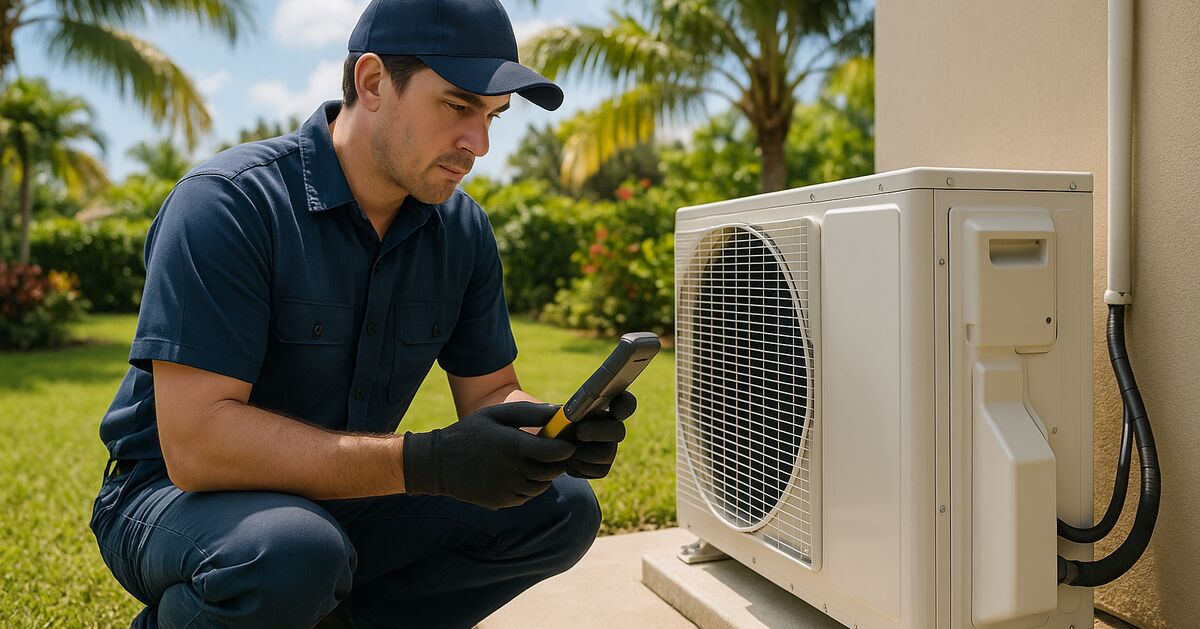
Your mini-split just stopped cooling on a July afternoon in Sarasota, the technician is standing in your living room, and you have maybe ten minutes to decide whether to repair or replace. That is a terrible position to be in without a framework, so here is one you can actually use.
The repair-vs.-replace question is not just about the cost of today's fix. It is about the age of the unit, the nature of the failure, what the next failure is likely to cost, how efficient the system is compared to what you could buy today, and how much of your home's comfort depends on that single unit. Work through those five lenses and the right answer almost always becomes obvious.
Start with the unit's age
Mini-splits in Florida typically last 15 to 20 years when they are properly maintained and installed, though the salt air near Anna Maria Island, Casey Key, and the Bayshore Gardens waterfront can shorten that lifespan if the outdoor unit is never cleaned or coated. A system that is 12 or fewer years old with no history of compressor problems is almost always worth repairing, provided the repair itself is not enormous. A system that is 16 or more years old deserves much harder scrutiny, because even after you pay for today's fix, the next part to fail could arrive within 12 months.
Think of it this way: a 17-year-old unit is past its median lifespan for Florida conditions. It has already delivered most of the value it was ever going to deliver. Putting $900 into it is a lot like putting new tires on a car with a cracked engine block - you may still end up stranded.
The sweet spot where age alone does not settle the argument is roughly 8 to 14 years. In that range, you need the other four lenses.
Understand what actually failed
Not every component carries the same replacement cost or the same signal about the unit's overall health. Here is a rough hierarchy from least to most serious:
- Capacitor or contactor. These are inexpensive parts that wear out predictably. A capacitor failure on a 10-year-old unit is not alarming - it is routine. Repair it without hesitation.
- Control board or inverter board. Pricier but still reasonable to replace on a unit that is 10 years old or younger, especially on a mid-range or premium brand.
- Blower motor or fan motor. Similar logic to the control board. Labor is the bigger cost here, so the age and quality of the unit should guide you.
- Refrigerant leak. This depends entirely on where the leak is. A leak at a flare fitting is a cheap fix. A leak inside the coil of an older unit is a different story entirely - you can read more about how to think through that specific decision in our post on mini-split refrigerant recharge vs. a real repair: how to tell the difference.
- Compressor failure. This is the big one. The compressor is the heart of the system and often costs more to replace than the unit is worth, especially once you add labor.
Compressor failure on a unit under warranty is a different story - parts costs may be covered - but for that to work, the warranty has to be intact. If you are not sure whether your coverage is still valid, it is worth reviewing what keeps a warranty alive in Florida's climate before making any decisions.
Apply the 50 percent rule - carefully
You will hear contractors cite the "50 percent rule": if the repair costs more than 50 percent of the price of a new comparable unit, replace rather than repair. It is a reasonable starting point, but it needs adjustment for the Florida context.
A new single-zone mini-split installed in Sarasota, Bradenton, or Lakewood Ranch typically costs more than a similar unit installed in a northern state, because of permit requirements, the extra work of protecting linesets from UV and salt exposure, and local labor rates. That means your 50 percent threshold is pegged to a higher replacement number than the national average. Use actual local quotes, not internet averages, when you run this calculation.
Also adjust the rule upward for age. On a seven-year-old unit, even a repair that costs 60 percent of replacement may make sense if the unit is otherwise healthy. On a 15-year-old unit, even a repair that costs only 30 percent of replacement may not make sense if the unit is nearing end of life. Age and repair cost work together, not separately.
Factor in efficiency honestly
Mini-split efficiency has improved significantly over the past decade. If you are running a system with a SEER rating in the low teens, replacing it with a modern high-efficiency unit could meaningfully reduce your electricity bill every month for the next 15 years. In Sarasota's climate, where systems run eight to ten months out of the year, that difference compounds quickly.
If you are weighing a significant repair on an older, lower-efficiency unit, take 15 minutes to get a rough estimate of what a modern replacement would cost to operate versus what your current unit costs. Your utility bills from the past 12 months give you a real baseline. Choosing the right SEER2 rating for your Florida mini-split walks through how to read those efficiency numbers in a way that actually translates to dollars.
The efficiency argument is not always a slam dunk for replacement - if the repair is cheap and the system is already reasonably efficient, the payback period on a new unit may be longer than the old unit's remaining lifespan. Do the math specific to your situation.
Think about what a failure means for your home
A mini-split serving a bonus room over a garage in Nokomis is a different situation from a multi-zone system serving the primary living spaces of a home in Lakewood Ranch with no backup cooling. If the failed unit is the only source of comfort for bedrooms where people actually sleep, the calculus shifts toward faster resolution, and sometimes that means replacement rather than waiting two weeks for a backordered part.
Similarly, if you are running a multi-zone system and one of the indoor heads or the outdoor unit itself is failing repeatedly, you have to weigh the disruption cost, not just the dollar cost, of another repair cycle.
For homeowners in Venice and Osprey who are renting their properties seasonally, a unit that is unreliable mid-season is a liability that goes beyond the repair invoice.
Warning signs that point firmly toward replacement
Even if the immediate repair seems manageable, these patterns suggest the unit is heading toward end of life:
- Repeated refrigerant top-offs without a diagnosed and repaired leak. Refrigerant does not get consumed - it leaks. If you are recharging every season, something has not been fixed.
- Second major component failure within 18 months. One compressor problem is bad luck. Two significant failures in quick succession is a pattern.
- Ice buildup that persists after cleaning and airflow checks. Chronic icing can indicate a refrigerant circuit problem or coil deterioration that is expensive to resolve.
- Noise that returned after a repair. Grinding, banging, or persistent rattling that comes back after a technician addressed it suggests the underlying cause was not resolved.
- Visible corrosion on the outdoor unit's coil fins. Near the water in communities like Casey Key or Downtown Venice, salt-air corrosion can reach a point where heat transfer is permanently compromised. A corroded coil can be cleaned to a degree, but severe pitting is irreversible.
When repair is clearly the right answer
Do not let a simple failure talk you into an unnecessary replacement. These situations almost always justify repair:
- The unit is under 10 years old and has had no major repairs previously.
- The failed component is minor (capacitor, relay, sensor, drain pump).
- The repair cost is under 30 percent of a comparable new installation.
- The unit is a higher-efficiency model that would be costly to match today.
- You have an active manufacturer's warranty that covers the parts.
Our team works across Sarasota, Bradenton, and Venice and we see homeowners replace systems that had years of reliable life left simply because a contractor did not explain what actually failed. Knowing the component matters.
The permit angle when you do decide to replace
If the repair-vs.-replace analysis lands on replacement, do not skip the permit step. Sarasota County and Manatee County both require permits for new mini-split installations, and pulling one is not just bureaucratic overhead - it protects you at resale and keeps your homeowner's insurance whole. If a contractor offers to do the job without a permit to save time or money, that is a firm reason to find a different contractor.
You can also explore the full range of mini-split installation and service options we offer to understand what a proper replacement job involves from start to finish.
Getting a second opinion is always reasonable
If a technician is recommending a compressor replacement or any repair over a few hundred dollars, asking for a second opinion before committing is not rude - it is sensible. A second technician may identify a simpler root cause, or may confirm the diagnosis and give you confidence that the recommendation is sound.
For homeowners across our service area, including Main Street at Lakewood Ranch, Downtown Sarasota, and the barrier island communities, we are happy to come out for a diagnostic visit and give you a straight answer on what we find. There is no pressure to replace what does not need replacing, and no incentive to patch what should be replaced.
If you are ready to talk through a specific situation, reach out to us directly and we can usually get a technician out within a day or two. A good diagnosis almost always makes the repair-vs.-replace decision straightforward.
The short version
Repair if: the unit is under 10 to 12 years old, the failed part is not the compressor, the repair cost is well under half of replacement cost, and there is no history of repeated failures.
Replace if: the unit is 15 or more years old, the compressor has failed, you have had two or more significant repairs recently, visible corrosion has compromised the outdoor coil, or the unit's efficiency is so low that operating savings from a new system would offset replacement costs within a reasonable number of years.
When the answer is not obvious, do the math with real local quotes, factor in the unit's age as a multiplier, and think about what a second failure in the next 12 months would actually cost you in time, comfort, and money. In most cases, that exercise makes the right call clear.