Mini-split refrigerant recharge vs. a real repair: how to tell the difference
Your mini-split is struggling to cool the bedroom, and a neighbor says, "Oh, it probably just needs a refrigerant recharge." That advice is sometimes right and often dangerously incomplete. Refrigerant does not evaporate, burn off, or get used up the way gasoline does. If your system is low on refrigerant, there is a reason, and simply topping it off without finding that reason is a short-term fix that can turn into a very expensive long-term problem.
This guide walks you through what refrigerant actually does, the signs that point toward a low-charge situation versus a different kind of failure, and exactly what a professional service call looks like here in Sarasota and the surrounding Gulf Coast communities.
What refrigerant does and why a "recharge" is not routine maintenance
A mini-split is a closed loop. The refrigerant inside it circulates between the outdoor compressor unit and the indoor air-handling head, absorbing heat from your room air and releasing it outside. Under normal conditions, that same charge of refrigerant circulates indefinitely for the life of the equipment, often 15 to 20 years or more.
Because the system is sealed, low refrigerant almost always means one thing: there is a leak somewhere in the circuit. The leak might be at a flare fitting that was not tightened correctly during installation, a pinhole in a copper line that was damaged by a landscaper or a pest, a corroded service valve, or, in older equipment, a refrigerant line that has simply developed a hairline crack over years of vibration.
Adding refrigerant without repairing the leak is like adding oil to your car engine every week without fixing the gasket that is letting it drain out. You will be calling for another "recharge" in six months, and in the meantime your compressor is running on a partial charge, which stresses it and shortens its life.
This distinction matters for your budget. A refrigerant top-off is relatively quick. Finding, accessing, and repairing a leak, pressure-testing the circuit, pulling a vacuum to remove moisture, and then recharging to the manufacturer's exact specification is a multi-step job. It takes longer and costs more up front, but it is the only repair that actually solves the problem. If you want a realistic sense of what professional mini-split service work runs in this region, our post on how much mini-split installation and service costs in Florida gives useful context on what labor and materials typically look like.
Signs that point toward a refrigerant issue
Not every cooling problem is a refrigerant problem. Here are the symptoms that most reliably suggest the system is undercharged:
- Warm or lukewarm air from the indoor head, even though the unit is running. The compressor is working but there is not enough refrigerant to carry heat out of the room effectively.
- Ice or frost forming on the outdoor unit's copper lines or on the indoor coil. This sounds counterintuitive, but low refrigerant causes the evaporator to get too cold, which freezes the moisture in the air around it.
- The system runs constantly without reaching the set temperature. It is cycling, trying to catch up, but the refrigerant circuit cannot transfer enough heat.
- Higher-than-normal electricity bills alongside reduced cooling. The unit is consuming power without delivering comfort.
- A hissing or bubbling sound near the line set or the indoor unit. That sound can indicate refrigerant escaping through a leak point.
If your system is showing most of these signs together, a refrigerant issue is plausible. But notice the word "plausible." A good technician will not assume this is the cause before doing some basic checks.
Signs that point toward something more serious
Several other failures produce symptoms that look similar to low refrigerant. A thorough diagnostic will rule these out before any refrigerant work begins:
- A dirty or blocked indoor coil. A coil choked with dust and mold, which is very common in coastal homes in Osprey, Nokomis, and Casey Key where salt air accelerates buildup, can restrict airflow so badly that the unit cannot transfer heat. Cleaning, not a recharge, is the fix. See our guide on why a mini-split blows warm air for a full breakdown of airflow-related causes.
- A failing or failed compressor. The compressor is the heart of the refrigerant circuit. If it has seized or is weak, the system cannot circulate refrigerant at the right pressure regardless of how much is in the circuit. Compressor replacement is a major repair that sometimes makes replacement of the whole outdoor unit more cost-effective.
- A faulty reversing valve. Mini-splits can both cool and heat because a reversing valve switches the direction refrigerant flows. A stuck or partially stuck reversing valve can cause the system to underperform in cooling mode even though refrigerant levels are fine.
- Electrical component failures. A bad capacitor, a faulty control board, or a malfunctioning thermistor can all cause reduced or absent cooling without any refrigerant issue at all.
- A refrigerant metering device blockage. A clogged expansion valve or metering orifice mimics low-charge symptoms almost exactly. Pressures will look odd, but adding refrigerant will not help.
This is why a pressure check and diagnostic comes before any decision about whether to add refrigerant. Skipping the diagnostic and going straight to a recharge is a red flag in any technician.
What a proper service call looks like, step by step
If you call us for a cooling complaint at a home in Bradenton, Lakewood Ranch, or anywhere in our service area, here is what an honest, thorough service call looks like in practice:
1. A visual inspection before any tools come out. The technician will look at the outdoor unit for obvious signs of physical damage, corrosion on the line set and fittings, oil streaks (which indicate refrigerant has been escaping and carrying compressor oil with it), and the condition of the electrical connections. The indoor head gets checked for airflow, coil cleanliness, and drain line condition.
2. An electrical check. Voltage and amperage at the outdoor unit are measured. A compressor drawing too many amps, or a capacitor that is out of spec, gets flagged before refrigerant work begins.
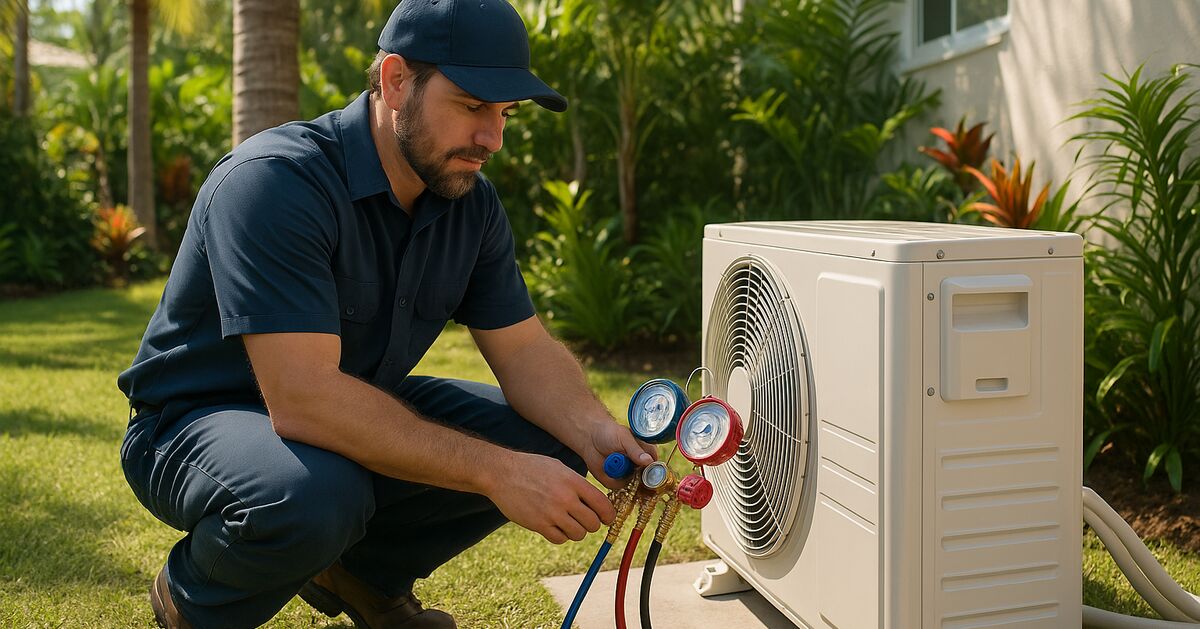
3. Pressure testing with a manifold gauge set. The technician connects gauges to the service ports and reads the suction pressure (low side) and discharge pressure (high side). Low suction pressure paired with low discharge pressure strongly suggests undercharge. But those pressures are interpreted in combination with outdoor air temperature, indoor humidity, and the specific refrigerant the unit uses, because what looks "low" on a 70-degree morning can look normal on a 95-degree Sarasota afternoon when the system is under peak load.
4. A leak search if pressures confirm undercharge. This usually involves an electronic leak detector passed along the line set, fittings, indoor coil, and outdoor unit components. Some technicians also use UV dye (injected into the system, then viewed with a UV light) for leaks that are slow and hard to find. A nitrogen pressure test can be used when the system has been fully evacuated and there is uncertainty about the location.
5. The repair, then the recharge. The leak gets fixed first. Then the system is evacuated with a vacuum pump to remove any air or moisture that entered the circuit. Only after a good vacuum holds does the technician recharge to the manufacturer's specified weight or pressure, depending on the system type. This last step is not a judgment call; the specification is printed on the outdoor unit's data plate and in the service manual.
6. A performance verification. After recharging, the system runs under load while the technician checks the temperature split (the difference between the air entering the indoor unit and the air leaving it), confirms pressures are stable, and makes sure the unit is reaching the set point. That confirmation step is how you know the repair actually worked.
How Sarasota's climate affects refrigerant diagnostics
Diagnosing refrigerant issues in Southwest Florida is genuinely different from doing it in, say, North Carolina. Our outdoor temperatures regularly push into the mid-to-upper 90s from May through September, and the humidity is extreme. Both factors affect refrigerant pressures, which means a technician who learned their trade in a cooler climate and is not accounting for ambient conditions here can misread a normal system as undercharged.
Salt air is a factor too. Homes on Anna Maria Island, Casey Key, and the barrier islands near Venice see accelerated corrosion on copper line sets and flare fittings. A joint that would last 20 years inland might develop a slow leak in 8 to 10 years in a salt-air environment. If you live near the water, it is worth having a technician look closely at exposed fittings during any service visit, even one that was called for a different reason.
Pest activity is another Sarasota-specific issue. Rats and squirrels occasionally chew through insulation on line sets, and even a small breach in the foam can lead to condensation damage on the copper underneath over time, eventually causing a pinhole leak.
What you should ask before agreeing to any refrigerant work
Before authorizing a technician to add refrigerant to your system, get clear answers to these questions:
- Did you check the pressures with gauges, or are you estimating based on symptoms alone?
- Did you find the source of the leak?
- What is the repair plan for the leak before you recharge?
- What refrigerant does my system use, and how will you charge it to spec?
A technician who cannot answer all four of those questions, or who suggests skipping directly to a top-off without a leak search, is not giving you the full picture. Our services page explains the approach we take on every diagnostic call, and our FAQ covers other common questions homeowners have before booking service.
When replacement makes more sense than repair
If the compressor has failed, the repair cost often approaches or exceeds the cost of a new outdoor unit. Similarly, if the leak is in the indoor coil itself (rather than in the accessible line set or fittings), coil replacement can be expensive enough that a full system replacement is the smarter financial move, especially on a unit that is already 10 or more years old.
Age and refrigerant type matter here too. Older systems that use R-22 refrigerant are now facing significant recharge costs because R-22 is no longer manufactured in the United States and the remaining supply is expensive. If your system uses R-22, a refrigerant issue is often the nudge that makes replacement with a modern R-410A or R-32 system the practical choice.
For homeowners considering a new installation after a repair-or-replace decision, our ductless mini-split services can walk you through the options that make sense for your home's layout and your family's comfort goals.
The bottom line
A refrigerant recharge can be the right fix, but only after a proper diagnostic confirms that refrigerant is actually the problem, the source of the loss has been found, and the leak has been repaired. Anything less is guesswork, and in Southwest Florida's heat, you will feel the consequences of guesswork very quickly.
If your system in Sarasota, Venice, Bradenton, or anywhere else on the Gulf Coast is not cooling the way it should, the right first step is a thorough service call from a technician who will actually diagnose before prescribing. Get in touch with us and we will schedule a diagnostic visit, explain what we find in plain language, and give you a clear picture of your options before any work begins.