Can I run my mini-split all day in Florida? The honest answer
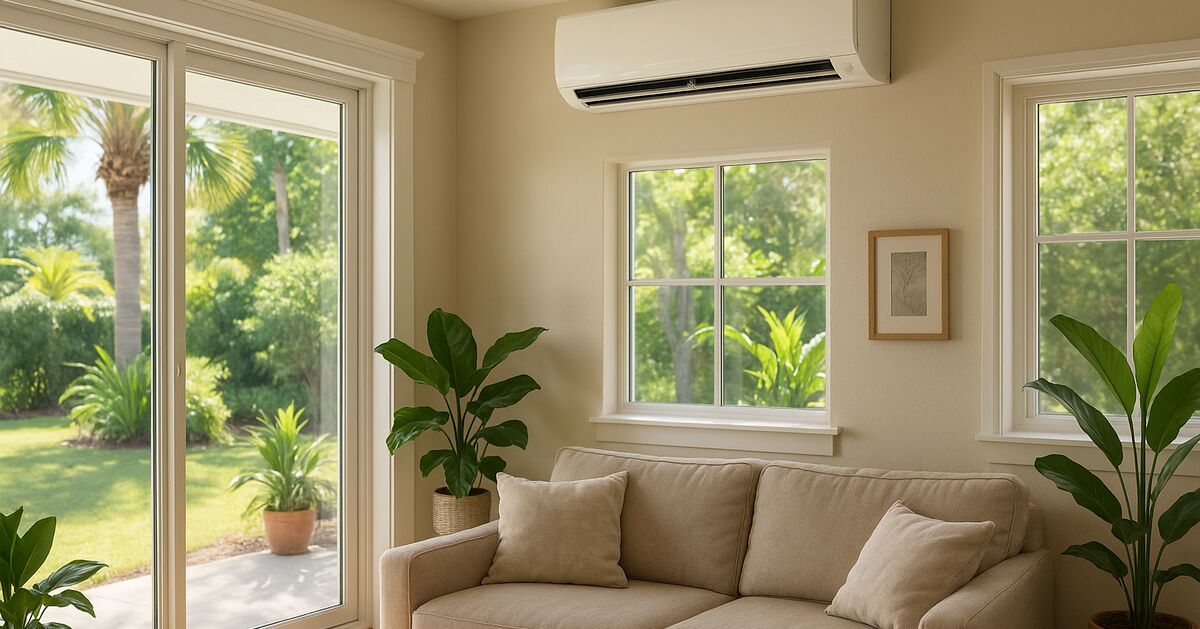
Running your air conditioner around the clock feels wrong - like leaving the faucet on or the oven warm overnight. But here in Sarasota, Bradenton, and across the Gulf Coast, the question "can I just leave my mini-split running all day?" comes up constantly, and the honest answer surprises most people.
Why Florida is a special case
Most energy advice about air conditioning was written for climates with cool nights, breezy afternoons, and low humidity for at least part of the year. Southwest Florida is not that place. From May through October, outdoor temperatures rarely dip below 75°F even at 2 a.m., and relative humidity hovers between 70 and 90 percent on most days. Shutting your mini-split off for several hours is not a "rest" - it is an invitation for heat and moisture to saturate your walls, furniture, and air. Getting the space back to a comfortable temperature and humidity level afterward costs far more energy than maintaining it would have.
This is the single most important concept for any homeowner in the Lakewood Ranch, Venice, or Anna Maria Island area to understand: mini-splits are designed for continuous, low-intensity operation, not for repeated on/off cycles.
How ductless mini-splits actually run
Traditional central air systems use fixed-speed compressors. They blast cold air at full power until the thermostat is satisfied, then shut completely off. That cycling is hard on the equipment and leaves temperature swings of three to five degrees between cycles.
Ductless mini-splits with inverter-driven compressors work differently. The compressor ramps up or down continuously to match the exact load the room demands at that moment. On a mild morning in Osprey or Nokomis, the unit might run at 30 percent capacity for hours. On a brutal July afternoon in Downtown Sarasota, it ramps toward full power. Because the compressor never fully shuts off and restarts from zero, it avoids the hard mechanical stress of cycling and uses only as much electricity as the moment requires.
This is why ductless mini-split installation and service professionals consistently say that running your system continuously - at a steady, comfortable set point - is gentler on the equipment than aggressive on/off control.
Will it raise my electric bill?
This is the follow-up question everyone asks, and it is fair. The answer depends on how you are using the system.
Running a mini-split at 78°F all day uses less energy than turning it off, letting the space climb to 88°F, and then demanding the unit drag everything back down. The compressor works hardest during that recovery period. Doing that repeatedly through a summer day adds up.
That said, there are habits that do waste electricity:
- Setting the temperature extremely low. Dropping the set point to 68°F all day in a humid Florida home forces the unit to work much harder than it needs to. A set point of 74 to 76°F is comfortable and reasonable for this climate.
- Leaving doors and windows open. A mini-split is conditioning a defined space. Every time a door is left open for long periods, you are effectively asking the unit to cool the outdoors.
- Ignoring the humidity side of the equation. If your unit is undersized or placed incorrectly, it will run continuously at full power and still struggle. Our post on why your mini-split isn't killing Gulf Coast humidity (and how to fix it) goes deeper on this specific issue.
If you are seeing electric bills that feel out of proportion, the cause is usually one of the above - not continuous operation itself.
What about wear and tear?
Homeowners worry that a unit running all day, every day will burn out faster. The reality is the opposite of what most people expect. Inverter compressors are engineered for long, steady runtimes. The mechanical stress comes from starting and stopping, not from running. Think of it like a car: idling on the highway at 60 mph puts far less strain on the engine than stop-and-go traffic.
Proper maintenance matters far more to the lifespan of your equipment than how many hours per day it runs. Dirty filters restrict airflow and force the compressor to work harder. Salt air on the Gulf Coast accelerates corrosion of coil fins if they are not cleaned regularly. Our seasonal mini-split maintenance checklist for Sarasota's salt-air climate walks through exactly what to do and when.
For homeowners in Bayshore Gardens, Casey Key, or anywhere along the waterfront, salt-air maintenance is especially important. A unit that is well maintained and runs continuously in a properly conditioned space will outlast a neglected unit that cycles on and off by several years.
The "away mode" question
What if you are leaving the house for a few days? This is where opinions vary, and we want to give you a practical answer rather than a simple rule.
For a weekend away in July, the smart move is not to turn the system fully off. Instead, raise the set point to 82 or 83°F. This keeps humidity under control - which is the real enemy of empty Florida homes (mold, musty odors, wood swelling) - without running at full capacity the whole time. Many mini-split remote controls and smart apps have a dedicated "away" or "energy save" mode that does exactly this automatically.
Turning the system completely off during a Florida summer, even for 48 hours, can allow humidity levels inside to climb high enough to cause damage and odors that take real effort to reverse. The energy you "save" is often offset by the recovery cost and, in some cases, remediation costs.
For longer absences of a week or more, the calculus is similar but the set point can be raised a degree or two further. The goal is always humidity control, not just temperature.
Does the type of installation affect this?
Yes, significantly. A mini-split that was sized correctly for the space, installed with proper refrigerant charge, and positioned for good airflow will handle continuous operation effortlessly. One that was undersized, overcharged, or placed in a spot with poor air circulation will strain under the same conditions.
Our post on whether your mini-split is the right size covers the sizing question in detail. If your unit seems to run at full blast constantly without ever reaching your set point, sizing or installation quality is almost certainly the issue - not the idea of running it continuously.
This is one of the reasons choosing an experienced local installer matters. A company familiar with Downtown Venice condos, the open floor plans common in newer Lakewood Ranch construction, or the older bungalows near Downtown Sarasota understands that each space has its own load characteristics. Generic sizing charts miss those nuances. You can read more about our approach and local experience if you want to know how we handle this.
Multi-zone systems and continuous operation
If you have a multi-zone system serving several rooms or areas of your home, continuous operation becomes even more practical. Each indoor air handler can be set independently. Bedrooms can run cooler at night. Common areas can be set back slightly during the middle of the day if no one is home. The outdoor compressor modulates to serve all the active zones together, often running more efficiently than a single-zone unit cycling on and off alone.
If you are still deciding between single-zone and multi-zone for your home, the comparison post on single-zone vs. multi-zone ductless systems lays out the trade-offs clearly.
Practical tips for running your mini-split continuously in Florida
Here is what we recommend to homeowners across our service areas, from Bradenton down to Venice:
- Set a consistent temperature and leave it. Pick a comfortable set point (74 to 77°F is common here) and do not chase the thermostat up and down through the day.
- Use the auto fan mode. Let the unit decide how hard to push air. Manual fan speed settings can interfere with the inverter's ability to modulate efficiently.
- Clean your filters every two to four weeks during summer. This is the single most impactful maintenance task you can do yourself.
- Keep the outdoor unit clear. Vegetation, mulch buildup, and debris around the condenser restrict airflow and force harder operation.
- Use "dry" or "dehumidify" mode on heavy-humidity days. Some days in August, the air is more wet than hot. Dry mode prioritizes moisture removal without overcooling the space.
- Schedule a professional check once a year. A technician can verify refrigerant charge, clean the coil, and catch small issues before they become expensive ones.
When to call a professional
If your mini-split is running continuously and still not reaching the set point, or if it is keeping up but your electric bill has climbed noticeably, those are both signs worth investigating. Common culprits include low refrigerant charge, a dirty evaporator coil, failing capacitors, or a unit that was never sized correctly for the space.
Our team serves homeowners throughout Sarasota, Bradenton, Lakewood Ranch, Venice, Osprey, and Nokomis. If something feels off about how your system is performing, reaching out for a diagnostic visit is almost always worth it before the problem compounds through a full summer season.
You can get in touch with us here to schedule a visit or ask a question. We are happy to talk through what you are seeing before you commit to anything.
The bottom line
Running your mini-split all day in Florida is not only fine - for most of the year, it is the right strategy. The inverter technology these systems use is built for exactly this kind of steady, demand-matched operation. The enemies of your equipment and your comfort are aggressive temperature swings, neglected maintenance, and poor original installation, not continuous runtime.
Set it to a reasonable temperature, keep the filters clean, and let the system do what it was engineered to do. Your home will stay comfortable, your equipment will last, and your electric bill will likely be lower than if you kept switching things off and on trying to "save" energy the way older systems demanded.