Why mini-split line sets corrode faster on island properties - and what holds up
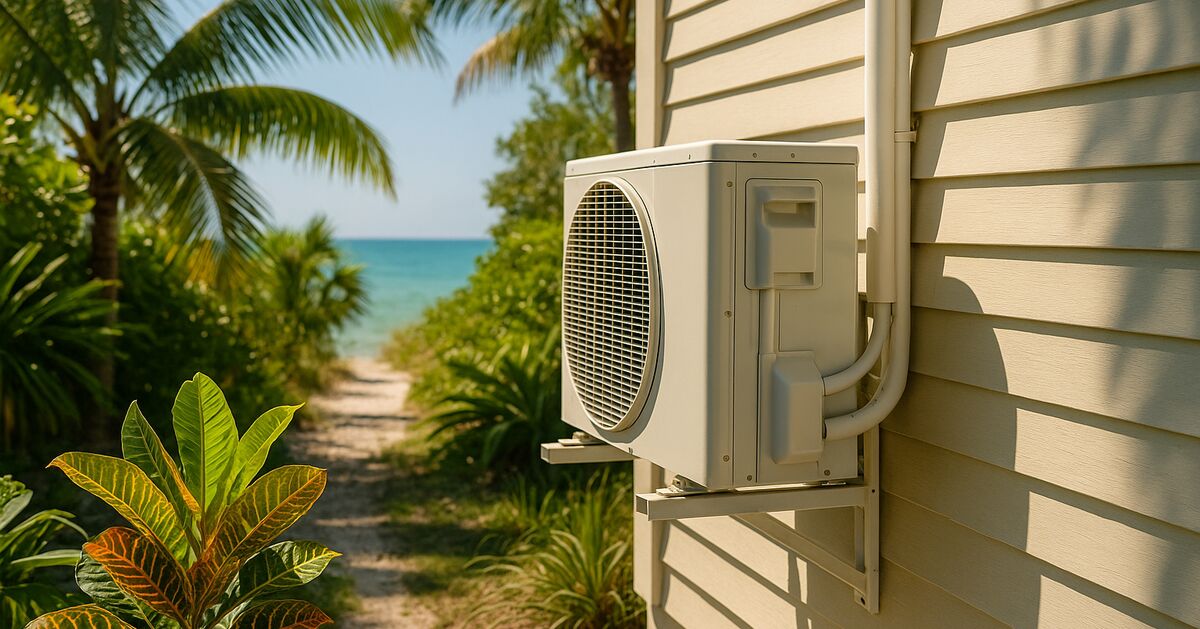
Salt air on Anna Maria Island and Casey Key doesn't just rust cheap patio furniture - it quietly destroys mini-split line sets from the outside in. If you've ever seen a refrigerant line that looks fine from a distance but crumbles when you touch the insulation, you've already seen coastal corrosion at work. This post is about understanding exactly why that happens so fast on barrier islands, and what materials, installation details, and maintenance habits actually hold up when you're living within a mile or two of the Gulf.
What makes barrier island air so corrosive
The short answer is airborne salt. But the mechanism matters if you want to make good decisions about your equipment.
When Gulf breezes blow across open water and onto Anna Maria Island or Casey Key, they carry tiny droplets of saltwater in suspension. Those droplets land on every exterior surface, including the copper refrigerant tubing, the aluminum fins of your outdoor condenser, the electrical conduit, the line-set jacket, and every bit of metal hardware that holds it all together. When the droplets evaporate, they leave behind sodium chloride crystals. Salt is hygroscopic, meaning it pulls more moisture from the air, stays wet even on "dry" days, and accelerates the electrochemical reaction we call corrosion.
It gets worse with geography. Homes on the west-facing side of Anna Maria Island - particularly those in Holmes Beach or Bradenton Beach with an unobstructed view of the Gulf - receive a near-constant salt-laden breeze. Casey Key, a narrow barrier strip between Sarasota Bay and the Gulf, gets salt exposure from both sides. Even homes that aren't technically beachfront still sit in what atmospheric scientists call the "marine boundary layer," which for most of the Gulf Coast extends somewhere between one and several miles inland depending on wind patterns and vegetation.
Compare this to an inland installation in Lakewood Ranch or Bradenton. Those homeowners deal with humidity and heat, but the air chemistry is meaningfully different. A line-set jacket that lasts fifteen years in Lakewood Ranch might show serious degradation in five years on Anna Maria Island if the wrong materials were used.
What actually corrodes - and in what order
A mini-split line set has several components, and they don't all fail at the same rate.
The foam insulation jacket is usually the first thing you'll see deteriorate. Most standard line-set insulation is closed-cell elastomeric foam - think the black tubular foam you see running along exterior walls. This material handles temperature and moisture reasonably well inland, but UV radiation from Florida's sun breaks down the outer surface over time, and salt crystals that accumulate in any surface cracks act as an abrasive during thermal expansion cycles. Once the jacket develops cracks or gaps, moisture gets inside. Wet insulation against copper is a problem.
The copper refrigerant tubing is next. Copper is naturally corrosion-resistant in most environments - that's why it's the industry standard for refrigerant lines. But in a marine environment, a specific reaction called formicary corrosion (or "ant's nest" corrosion) becomes a real risk. Formic acid, which can form when organic compounds from the air interact with moisture and heat, attacks copper from the inside out, creating tiny pinholes. You may run for a year or two with a very slow refrigerant leak before a technician can even find it with a sniffer. The outside of the copper can also develop pitting corrosion where the surface has been compromised by salt and moisture.
Electrical conduit and connections are often the most overlooked weak point. Many installations use standard PVC conduit for the electrical line running between the indoor and outdoor units, which handles salt air reasonably well. But the connectors, junction boxes, and metal conduit fittings - especially if they're galvanized steel rather than stainless or UV-stabilized composite - can develop rust spots that spread into the wiring. Corroded electrical connections cause resistance, which causes heat, which causes failures that look electrical when they're actually the result of a materials problem.
The outdoor condenser cabinet itself has aluminum fins over a copper coil, and the fins are the most vulnerable part. Most manufacturers apply some level of coating to these fins, but the coating isn't equal across brands or product lines. "Coastal" or "marine-grade" condenser coils exist for exactly this reason, with heavier hydrophilic or epoxy coatings that resist salt attack far longer.
Mounting hardware and line-set clips seem minor but matter. Zinc-coated screws and clips are standard practice inland. On barrier islands, they begin to show rust within a few seasons. Once they fail, line sets sag, insulation joints open up, and moisture intrusion accelerates everywhere.
The materials that actually hold up
Knowing what fails is useful. Knowing what to ask for is what actually protects your investment.
For line-set insulation, the step up from standard closed-cell foam is an insulation with a built-in UV-resistant outer jacket - sometimes called "UV-rated" or "solar-grade" foam. Some installers go a step further and cover the entire exterior run with a UV-resistant PVC line-set cover (the kind that snaps together in sections). This keeps sunlight and salt spray off the insulation entirely and adds a layer of physical protection. On a Casey Key installation where the outdoor condenser is on the Gulf side of the home, this is worth the added cost.
For the condenser coil, look specifically for manufacturers that offer a "Blue Fin," epoxy-coated, or polymer-coated condenser coil as part of their coastal or severe-environment product line. Several brands that our team installs and services offer these coatings as a standard feature on select models or as an upgrade option. An epoxy-coated coil on Anna Maria Island is not an upsell - it is the baseline that makes sense.
For electrical work, marine-grade conduit fittings, stainless steel hardware, and watertight junction boxes are the right call anywhere within a mile or two of open water. PVC conduit itself is fine; the metal transition fittings and mounting clips are where you need to specify materials carefully.
For mounting screws and line-set clips, stainless steel fasteners throughout. They cost a bit more than galvanized at the hardware store level, but the difference is meaningful when you're not pulling everything apart to replace rusted hardware in year four.
For the copper itself, the most effective protection is keeping the insulation jacket intact and completely sealed. Where refrigerant lines pass through exterior walls, the penetration should be sealed with a marine-grade, UV-resistant caulk and a proper wall sleeve, not just foam backer rod pressed into the gap. Gaps let moist, salty air move through the wall assembly and directly contact the copper.
Installation details that matter as much as materials
The best materials still fail if the installation cuts corners.
Line-set routing on coastal properties should minimize the length of exposed exterior run whenever possible. A line set that travels mostly inside the building wall - even if that routing is a little longer overall - stays drier and cooler than one strapped to the exterior of a stucco wall with a Gulf view. Line set placement decisions are genuinely worth thinking through before installation day, because what gets buried in the wall or routed through a chase can't easily be changed later.
Drainage and slope matter more on humid coastal properties. If any portion of the line-set cover or conduit can trap standing water, it will. Salt water sitting in a crevice is far more corrosive than salt air passing over a surface. Every horizontal run should have a slight slope toward drainage, and any joint or cover section should be sealed to prevent water entry.
Condenser placement is worth revisiting if you're planning a new installation. On a property where the Gulf is directly to the west, a condenser mounted on the west wall of the home gets the most direct salt-air exposure during Gulf breezes. If the home's layout allows it, a north or east-facing installation location or a spot sheltered by a screen enclosure reduces the daily salt load on the unit meaningfully. This isn't always possible, but it's the kind of thing worth discussing with your installer before the brackets go in.
Post-installation coating is an option some homeowners add after a standard installation. Products like corrosion-inhibiting sprays designed for HVAC coils can be applied to the outdoor condenser fins every season or two to slow deterioration. This is more of a maintenance measure than a substitute for proper materials, but it adds meaningful protection on a unit that's already installed.
What to expect on Anna Maria Island specifically
Anna Maria Island presents some of the most demanding conditions in our service area. The island is narrow enough that even homes on the bay side receive Gulf salt exposure during west winds - which is most of the year. Year-round rental properties face the added challenge of continuous operation with less owner oversight, meaning corrosion that would get caught and addressed in a primary residence can go unnoticed until it becomes a real repair.
If you're planning a new installation on Anna Maria Island, our post on cooling a casita or in-law suite on Anna Maria Island covers some of the structural and electrical realities of island construction that affect what's possible. The corrosion issue is a layer on top of those fundamentals.
For existing systems, an annual inspection that specifically looks at line-set insulation integrity, condenser coil condition, and hardware corrosion is genuinely worth scheduling. A technician who spots a cracking jacket or pitted coil fins during a maintenance visit saves you from a refrigerant leak diagnosis call later.
What to expect on Casey Key
Casey Key has a character all its own. Many of the homes there are older, some with original construction from the 1950s through 1970s, which means the electrical panels and exterior wall assemblies weren't designed with modern mini-split line-set routing in mind. Salt exposure comes from both the Gulf and Sarasota Bay sides of the key, and there's very little windbreak.
Our post on cooling boat docks, lanais, and outdoor structures on Casey Key gets into some of the access and exposure specifics of that geography. Line-set corrosion on outdoor and semi-outdoor installations is even more accelerated because there's no building envelope protecting any portion of the run.
For Casey Key homeowners with existing mini-splits, one of the most common findings we see is standard line-set insulation that has UV-degraded to the point where it's essentially crumbling in sections, with the copper underneath showing surface discoloration. That's not an emergency in every case, but it's a sign that the system is working harder to maintain efficiency and that a refrigerant leak isn't far off.
How to think about the long-term cost
A coastal-spec installation costs more upfront. UV-rated insulation, epoxy-coated condenser coils, stainless fasteners, marine-grade electrical fittings - none of these are dramatically expensive as individual items, but they add up to a noticeably higher materials cost than a standard inland installation.
What you're buying is a longer gap between that installation cost and your next major repair or replacement. If a standard installation on a barrier island needs condenser coil replacement in year six and line-set insulation replacement in year eight, and a properly spec'd coastal installation defers those costs by several additional years, the math usually favors spending the money upfront - especially for a primary residence or a property that earns rental income.
For homeowners who want to understand what drives installation costs more broadly, our frequently asked questions page covers a lot of the variables that affect what a given project actually runs.
The other piece of the long-term picture is maintenance. No materials, however good, are maintenance-free in a marine environment. Rinsing the outdoor condenser with fresh water a few times a year to remove salt buildup - especially after storms - is a simple habit that extends coil life. Checking the line-set jacket visually every season for cracks or gaps, and addressing them with UV-rated tape or fresh sections of cover before moisture gets inside, is exactly the kind of small maintenance action that prevents a warranty-voiding refrigerant loss down the road.
Getting the right installation from the start
The most important moment is before the first bracket goes in. Specifying the right materials for a coastal installation requires a conversation with your installer about where the system is going, what the salt exposure looks like from that specific location, and what your long-term ownership plan is. A technician who installs primarily in Lakewood Ranch or inland Bradenton may default to standard materials out of habit, not negligence. The conversation about coastal specs is one worth having explicitly.
Our team covers Anna Maria Island, Casey Key, and the full Gulf Coast area from Bradenton south through Venice, and we deal with these conditions on a regular basis. If you're planning a new installation or wondering whether an existing system has been set up to handle the environment it's actually in, reach out and we're glad to take a look.
Salt air is just part of life on the coast. With the right materials and a bit of seasonal attention, it doesn't have to be what ends your mini-split system prematurely.